Introduction
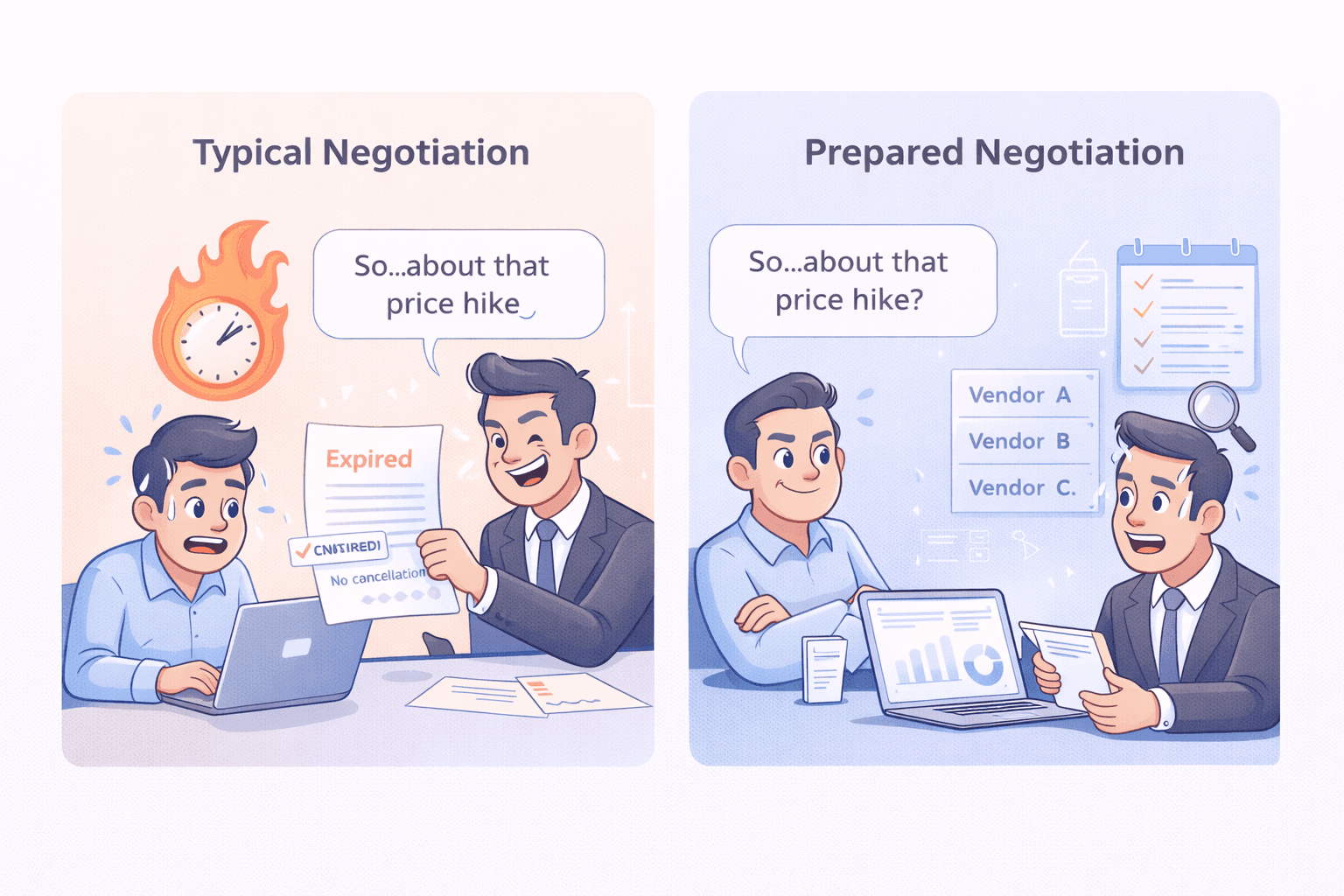
Many companies believe SaaS negotiation happens during vendor calls.
Procurement schedules a meeting. Pricing is discussed. Discounts are requested. Contracts are reviewed.
But in reality, most SaaS negotiations are decided much earlier.
Long before the vendor meeting takes place, companies either gain leverage or lose it entirely.
The difference usually comes down to preparation.
Organizations that approach renewals with clear usage data, alternative vendors, and enough time before deadlines negotiate from strength.
Those that discover a renewal two weeks before the notice period expires are simply managing damage.
A situation many teams recognize
A company receives a renewal notification for a major SaaS platform.
The contract renews in thirty days.
Finance is surprised by the price increase. Procurement is asked to negotiate. IT confirms the tool is still used by several teams.
Everyone agrees that the cost feels high.
But when the negotiation call happens, the vendor knows something the customer does not.
The company has already missed the cancellation window.
At this point the leverage is gone.
Negotiation still happens, but the outcome rarely changes dramatically.
The preparation gap
The biggest problem in SaaS negotiations is not vendor strategy. It is internal visibility.
Most companies lack a structured way to prepare for renewals months in advance.
Contracts live in shared folders. Renewal dates are buried inside legal documents. Ownership of vendors is unclear.
As a result, renewals are often discovered too late.
By the time finance or procurement begins evaluating the contract, the timeline already favors the vendor.
Mistake 1: Discovering renewals too late
Many SaaS contracts contain notice periods that require cancellation or modification decisions well before the renewal date.
Common notice windows include thirty, sixty, or even ninety days.
Missing these deadlines automatically extends the contract for another year.
Companies often discover the renewal when the invoice arrives rather than when the decision window opens.
At that moment, negotiating power is already reduced.
Mistake 2: Negotiating without usage data
Even when negotiations begin early enough, companies frequently lack reliable usage information.
They know how much the software costs, but not how many people actively rely on it.
Without usage insight, teams struggle to challenge license quantities or pricing tiers.
Vendors recognize this immediately.
When customers cannot confidently reduce licenses or adjust scope, negotiations become limited to small discounts rather than meaningful contract changes.
Mistake 3: No alternative vendors prepared
Another common issue is the absence of alternatives.
Vendors are far more flexible when customers have evaluated competing solutions.
But evaluating alternatives requires time.
If procurement only begins exploring options a few weeks before renewal, switching becomes unrealistic.
The vendor understands this constraint and negotiates accordingly.
Mistake 4: Unclear internal ownership
SaaS vendors often serve multiple teams inside a company.
A collaboration platform may involve IT, operations, and several business units.
Without a clear internal owner responsible for the vendor relationship, renewal preparation becomes fragmented.
Different teams have partial information but nobody coordinates the decision.
When renewal time arrives, discussions happen quickly and decisions are made with limited context.
What strong negotiation preparation looks like
Companies that negotiate SaaS contracts successfully typically follow a simple preparation process.
Renewals are identified months in advance. Contract terms and notice deadlines are clearly visible.
Usage insights are collected from business teams that actually use the software.
Alternative vendors are reviewed early enough to create credible options.
By the time negotiations begin, the organization understands the contract, the market, and its internal usage.
Vendors quickly recognize when customers come prepared.
How Venduris helps companies prepare earlier
The biggest challenge in SaaS negotiations is not the negotiation itself.
It is knowing when to start preparing.
Venduris helps organizations track SaaS contracts, renewal timelines, and notice periods in a shared workspace.
The platform automatically creates renewal instances months before deadlines, ensuring finance, IT, and procurement teams can review contracts early.
Usage insight can be collected from business users and attached to each renewal decision.
Instead of discovering renewals too late, companies approach vendor discussions with time, data, and internal alignment.
Final thoughts
SaaS vendors negotiate every day.
Most companies only negotiate contracts once a year.
The organizations that succeed are not necessarily better negotiators. They are simply better prepared.
When renewals are visible early and usage data is available, the balance of the negotiation changes.
And that preparation often begins long before the first call with the vendor.