Introduction
Most SaaS contracts are carefully reviewed once.
The moment the company signs them.
After that, they tend to disappear.
The document is stored somewhere inside a legal folder, attached to an email thread, or uploaded to a document repository.
Months later the tool becomes part of daily operations.
Then one year passes.
Eventually a renewal notification arrives, and suddenly someone needs to read the contract again.
At that moment teams often realize they should have looked at it much earlier.
A familiar situation
A procurement team prepares for a SaaS renewal.
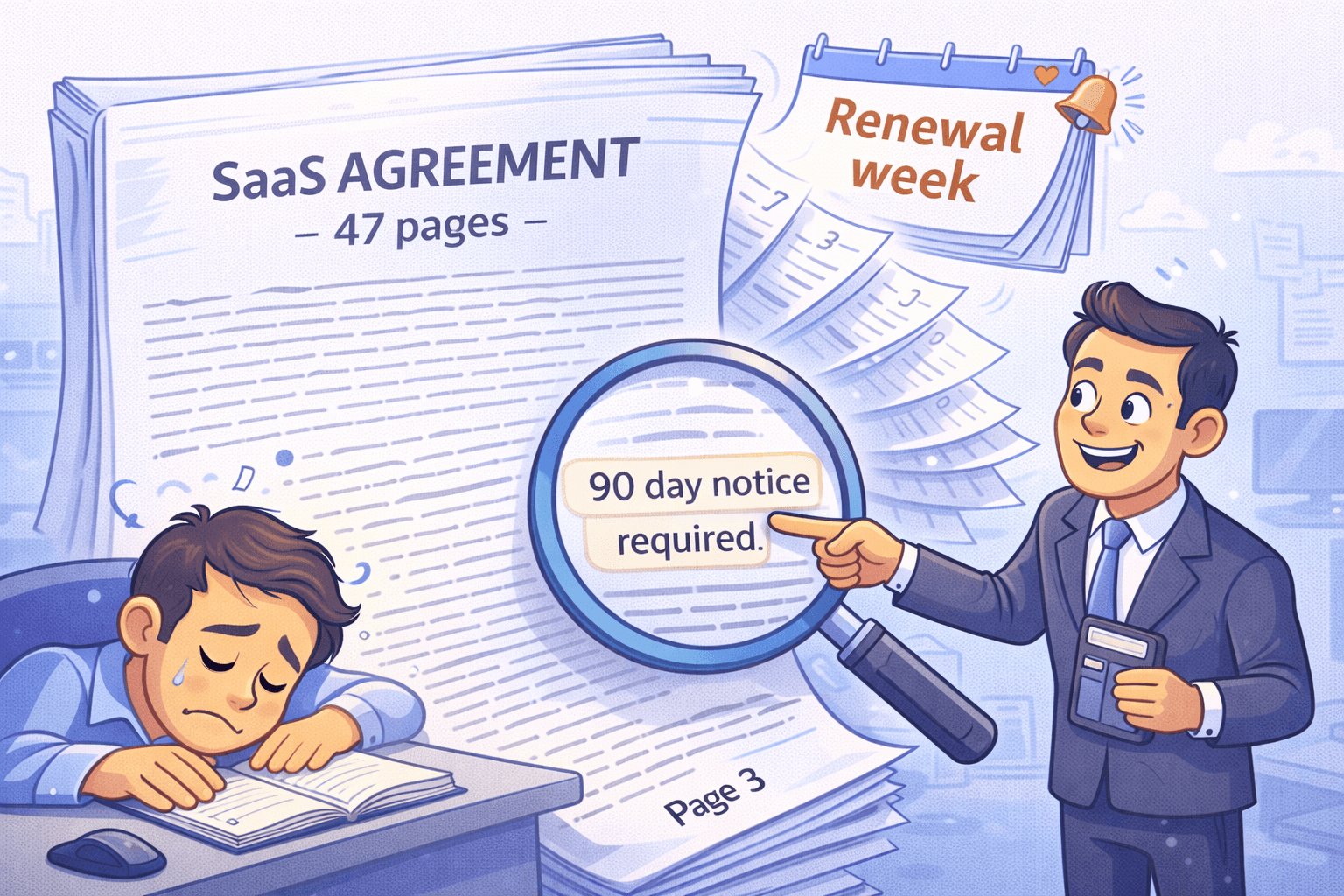
The vendor mentions that cancellation requires ninety days notice before the renewal date.
Nobody remembers seeing that clause.
The contract is opened again and after a few minutes of searching, the clause appears buried inside the terms.
Unfortunately the deadline passed two weeks earlier.
The contract renews automatically for another year.
Why SaaS contracts are rarely revisited
The reality is simple.
Contracts are long, dense, and rarely urgent.
Once a tool is deployed and working, teams focus on operations rather than legal terms.
Nobody has a strong incentive to read the contract again until renewal approaches.
This creates a gap between contract knowledge and operational reality.
The organization uses the software daily while the contract remains mostly forgotten.
Important clauses that often go unnoticed
Several contract terms become critical only at renewal time.
Notice periods determine when cancellation or renegotiation must happen.
Price uplift clauses define how pricing may increase each year.
Termination conditions affect whether the company can reduce scope during the contract.
Without reviewing these terms early, companies often discover them only when the negotiation window is already closing.
The timing problem
The biggest issue is not the contract itself.
It is timing.
By the time companies revisit SaaS agreements, the decision window is already approaching.
Teams rush to understand the terms, gather usage insight, and coordinate internal feedback.
Negotiations then happen under pressure rather than preparation.
Why contract visibility matters
Organizations that manage SaaS contracts effectively do something simple.
They make contract information visible long before renewal deadlines.
Renewal dates, notice periods, and pricing terms are surfaced early enough for teams to prepare decisions calmly.
Instead of rediscovering contracts at the last minute, the organization understands its commitments months in advance.
How Venduris simplifies SaaS contract visibility
Venduris extracts key contract information automatically, including renewal dates, notice deadlines, pricing structures, and contract terms.
Instead of manually searching through documents, finance, IT, and procurement teams gain a clear view of upcoming renewals and contractual commitments.
This allows teams to revisit agreements at the right moment rather than when it is already too late.
Final thoughts
SaaS contracts are rarely ignored intentionally.
They simply become invisible after the initial signature.
But the terms inside those documents continue to shape renewal decisions every year.
The companies that manage SaaS vendors effectively are not reading contracts more carefully.
They are simply making the right information visible at the right time.