Introduction
Anyone who has negotiated SaaS contracts has experienced the same moment.
Two companies use the same software.
Both have similar team sizes.
Yet they pay completely different prices.
SaaS pricing rarely follows clear logic from the outside. Discounts vary widely, bundles differ between customers, and list prices often feel detached from reality.
For many buyers, the process feels opaque.
But the complexity is not accidental.
The illusion of the price list
Most SaaS vendors publish a price list.
It creates the impression that pricing is standardized.
In reality, very few enterprise customers pay those prices.
List pricing mainly acts as an anchor for negotiations.
Actual contracts often include volume discounts, custom bundles, feature tiers, and multi-year commitments.
Two organizations buying the same product can end up with very different agreements.
Pricing models multiply complexity
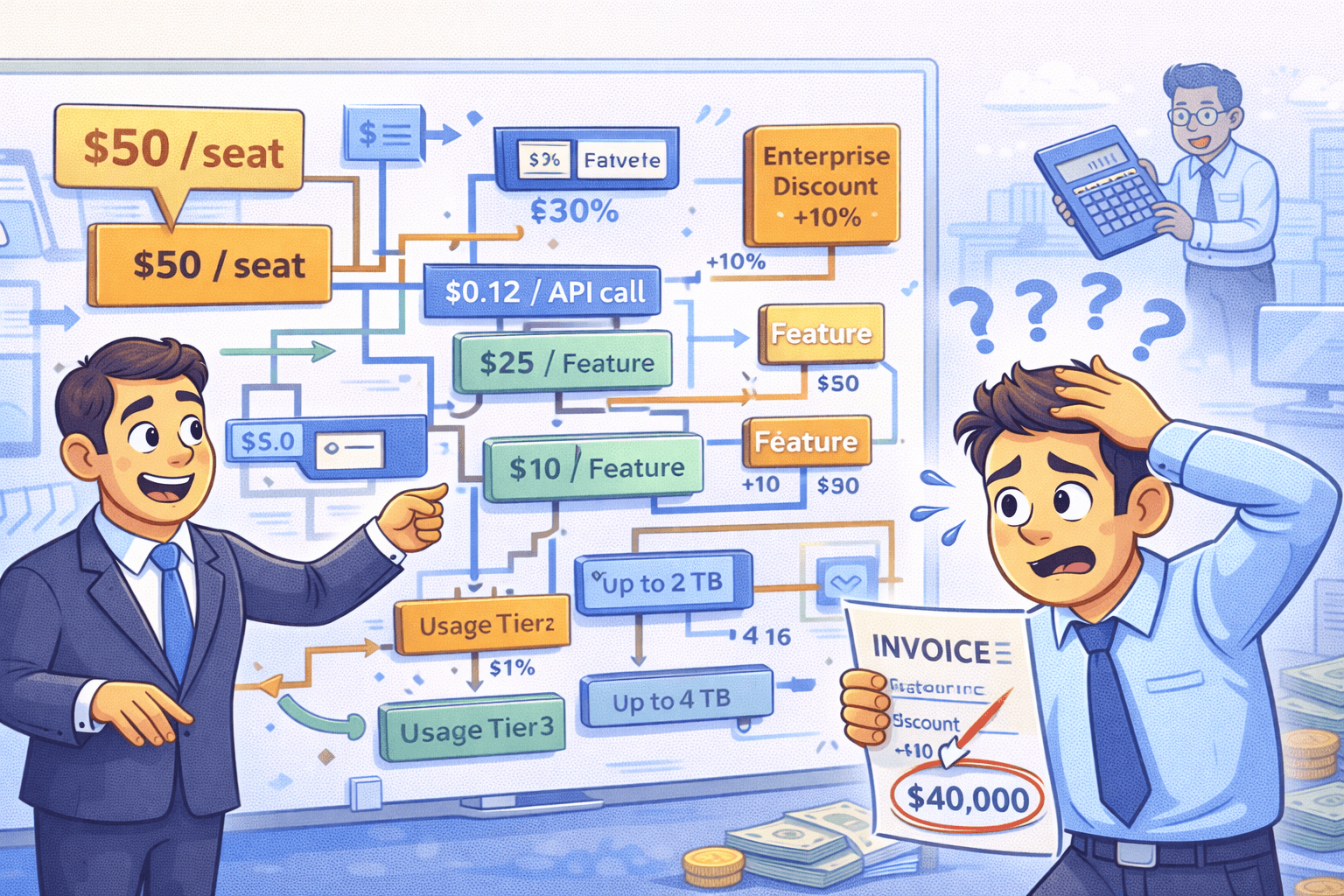
Modern SaaS pricing rarely follows a simple per-user structure.
Instead, vendors combine multiple variables.
Some products charge per seat. Others charge per usage event, API call, data volume, or feature tier.
Many combine several pricing dimensions at the same time.
The result is a pricing structure that becomes increasingly difficult to compare across vendors.
Sales incentives shape pricing
Another factor is the role of SaaS sales teams.
Account executives have flexibility to structure deals in ways that maximize the likelihood of closing.
Discounts may depend on timing, quarter-end pressure, expansion potential, or competitive threats.
Pricing therefore becomes partially influenced by the negotiation context rather than purely by product value.
Why buyers struggle to benchmark
Because contracts vary so much, benchmarking becomes difficult.
Companies rarely know what similar organizations actually pay.
Without that visibility, negotiation often starts from the vendor's pricing structure instead of the buyer's objectives.
The discussion becomes reactive rather than strategic.
Preparation changes the dynamic
Organizations that approach SaaS renewals with structured preparation tend to achieve better pricing outcomes.
They understand their usage patterns.
They know how the software compares with alternatives.
And they start the negotiation process early enough to create options.
Preparation transforms the conversation from a price discussion into a value discussion.
How Venduris helps clarify pricing
Venduris helps teams analyze historical contract pricing, renewal trends, and usage patterns across their SaaS portfolio.
This allows finance and procurement teams to enter negotiations with clearer context.
Instead of negotiating blindly, they understand how contracts evolved and where optimization opportunities exist.
Final thoughts
SaaS pricing feels confusing because it is designed to be flexible.
Vendors tailor contracts to each customer situation.
For buyers, the challenge is not eliminating complexity.
It is entering negotiations with enough visibility and preparation to navigate it confidently.